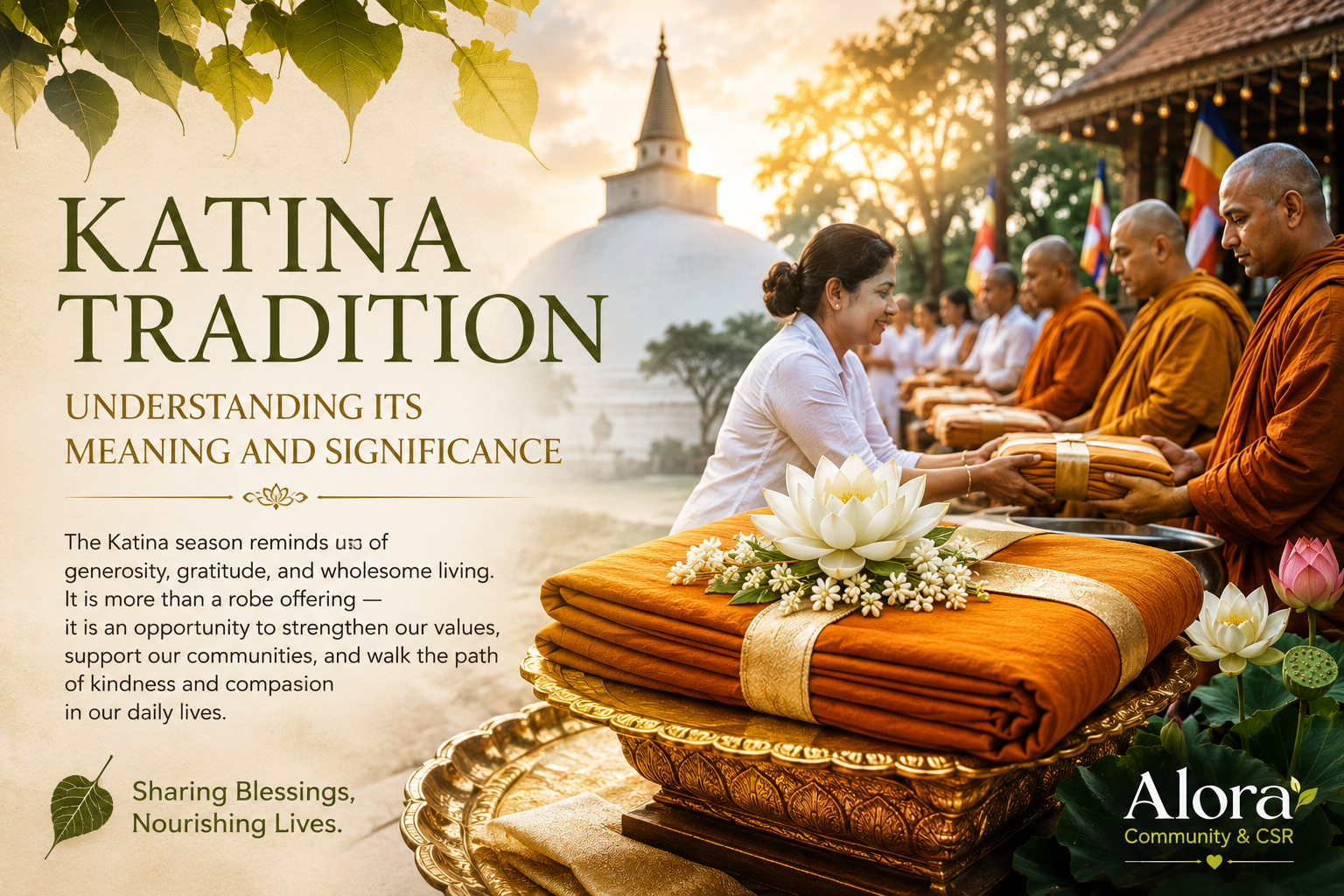
Katina Tradition – Understanding Its Meaning and Significance
Sharing Blessings, Nourishing Lives
The Katina season is one of the most significant and respected traditions in Sri Lankan Buddhist society, preserved with devotion and reverence across generations.
Yet the Katina tradition is more than the ceremonies and offerings we see. At its heart are deeper values of generosity, gratitude, commitment, community spirit, and the effort to live a wholesome life.
For younger generations in particular, preserving this tradition means not only continuing its practices, but also helping them understand why it matters.
What Is Katina?
During the Buddhist Rain Retreat, or Vassāna, monks traditionally remain at a monastery for a continuous period of three months. Following the completion of the retreat, the offering of a Katina robe to the Sangha is observed according to the Buddhist monastic tradition.
The offering of the Katina robe is regarded as a particularly significant form of offering because of its connection with the completion of the Rain Retreat and the specific traditions associated with it.
Therefore, Katina is not simply the presentation of a robe or other requisites. It is also an occasion that strengthens the respectful relationship between the Sangha and the lay community.
The Deeper Meaning of the Katina Season
Generosity (Dāna) has a special place in the Katina season.
Giving is not simply about transferring something we possess to another person. It can help us reduce attachment and develop an attitude of sharing and concern for the wellbeing of others.
The value of giving, therefore, is not measured only by the material value of what is offered. The intention, sincerity, and spirit behind the offering are also important.
Even a simple offering, when made with genuine faith and an unselfish mind, can carry profound meaning.
Āmisa Pūjā and Pratipatti Pūjā
When we reflect on the Katina tradition, it is also valuable to understand the relationship between Āmisa Pūjā and Pratipatti Pūjā.
Offering robes, food, accommodation, and other requisites to the Sangha is part of Āmisa Pūjā. Such offerings are meaningful expressions of faith and gratitude.
At the same time, the deeper purpose of Buddhist practice is to transform the way we live.
Cultivating wholesome thoughts, speaking wholesome words, maintaining ethical conduct, developing loving-kindness and compassion, and bringing the teachings of the Dhamma into our lives are central to the idea of Pratipatti Pūjā.
Therefore, Āmisa Pūjā and Pratipatti Pūjā need not be seen as competing ideas. Material offerings can express our devotion, while wholesome conduct gives that devotion a continuing expression in our daily lives.
From a Religious Offering to a Way of Living
If we participate in a Katina ceremony and return to exactly the same habits and attitudes afterwards, we may miss an important opportunity for personal reflection.
The Katina season gives us an opportunity to look at our own lives.
From today, we can choose:
- Patience instead of anger.
- Loving-kindness instead of resentment.
- Responsible use of resources instead of waste.
- Concern for others instead of thinking only of ourselves.
- Setting a good example for children through our actions, not merely our words.
- Helping others quietly, without expecting recognition.
Through such small changes, a religious observance can become a source of positive habits in everyday life.
Bringing the Katina Tradition Closer to the Younger Generation
When passing traditions from one generation to another, it is important to go beyond telling young people simply, “This is what we do.”
We should also help them understand:
“Why do we do this?”
When a young person participates in a Katina ceremony, they should have the opportunity not only to witness the robe offering, but also to understand the faith, commitment, generosity, cooperation, and community spirit behind it.
In this way, tradition becomes more than a ceremony inherited from previous generations. It becomes a living heritage that continues to provide meaningful values for life.
What Katina Teaches Our Communities
During the Katina season, we often see an entire community working together.
One person prepares food.
Another helps clean the temple.
Someone contributes their time.
Another provides something that is needed.
When all these contributions come together, a meaningful community activity becomes possible.
This carries an important lesson for society: a stronger community is built not by one person’s contribution, but through the combined efforts of many people who give what they can.
Values That Belong to Everyone
The Katina tradition comes from the Buddhist tradition, and its religious significance should be respected as such.
At the same time, many of the values reflected through this tradition—kindness, gratitude, generosity, respect, service, responsibility, and care for others—are values that can bring people together regardless of their religious or cultural background.
Sri Lanka is a country rich in religious and cultural diversity. By respecting each other’s traditions while recognising the human values we share, we can contribute to a more peaceful, understanding, and harmonious society.
Every Small Step Matters
The Katina season does not ask us only to do something great.
It reminds us that a small good action can also have great value.
Helping someone.
Sharing food.
Reducing waste.
Appreciating the work of a farmer.
Listening to an elder.
Being a good example to a child.
Or simply doing something kind without anyone knowing.
These small actions, repeated every day, can gradually make our communities better.
Alora’s Perspective
At Alora, we believe that the responsibility of a business does not end with producing a product and placing it in the hands of a customer.
Respecting the work of local farmers, promoting awareness of wholesome nutrition, using resources responsibly, appreciating our cultural heritage, and contributing to community wellbeing are also part of being a responsible business.
Through Alora Community & CSR, we hope to share positive values and educational content inspired by Sri Lanka’s diverse religious, cultural, environmental, and social traditions.
The Katina season is one of the first steps in this journey.
A Thought to Take With Us
The Katina offering reminds us of the value of generosity.
But beyond the offering, if we can make our thoughts, words, and actions more wholesome, the values of the Katina season can continue to live within us long after the ceremony has ended.
So, during this Katina season, perhaps we can each ask ourselves a simple question:
“What can I do today to bring a little more goodness into someone else’s life?”
Every sincere answer can become another small step towards building a kinder, stronger, and more harmonious society.
Sharing Blessings, Nourishing Lives.
About Alora Community & CSR
Alora Community & CSR is the long-term community engagement and Corporate Social Responsibility initiative of Alora, a brand of Suravi Holdings (Pvt) Ltd.
The initiative focuses on empowering local farmers, promoting healthy and wholesome nutrition, encouraging sustainable food systems, appreciating Sri Lanka’s cultural heritage, encouraging environmental responsibility, and contributing to community wellbeing.
While respecting the unique identity of every religious and cultural tradition, Alora Community & CSR seeks to create educational and meaningful initiatives that encourage knowledge, positive attitudes, responsibility, compassion, mutual respect, and social harmony.
Our aim is not simply to promote what we make, but to contribute to a better understanding of the values and practices that can help people, communities, and the country move forward together.