Read this article in: sinhala = https://suravi.lk/black-pepper-sinhala/
සිංහල
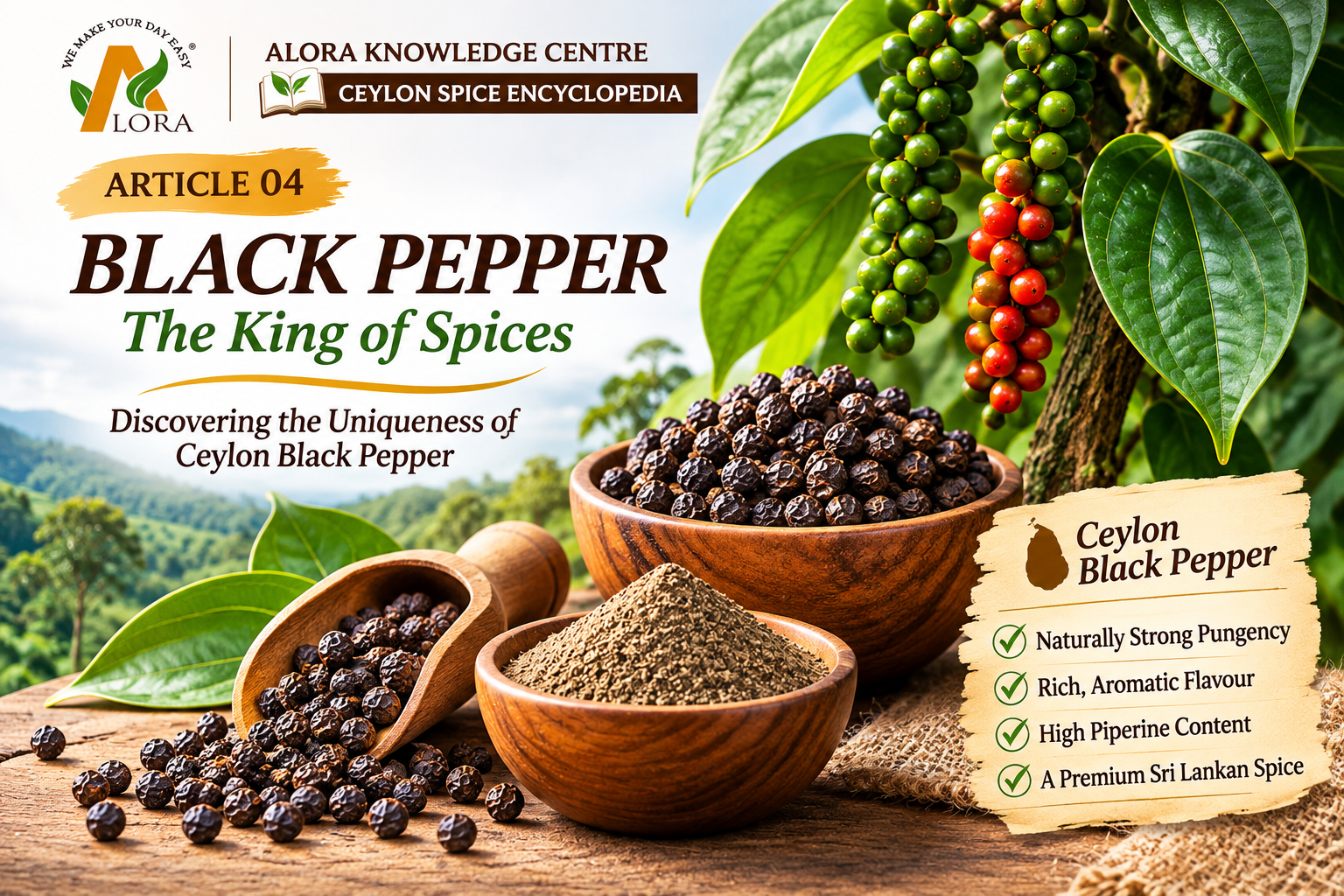
ARTICLE 04 – BLACK PEPPER
The King of Spices – Discovering the Uniqueness of Ceylon Black Pepper
1. What Is Black Pepper?
Black pepper, widely known as the “King of Spices,” is one of the world’s most popular and valuable spices. It is obtained from the dried berries of a climbing tropical vine scientifically known as Piper nigrum, belonging to the Piperaceae family.
The pepper plant produces small round berries arranged in clusters along its branches. These berries are harvested at different stages of maturity and processed to produce black, white and green pepper.
Black pepper is particularly valued for its sharp, warm pungency, distinctive aroma and versatility in cooking across different cultures.
2. Where Does Black Pepper Originate?
Black pepper originated in the South Asian region, particularly the Malabar Coast of present-day Kerala, India.
For centuries, pepper was one of the most valuable commodities in international trade. Ancient traders transported it along maritime routes connecting Asia, the Middle East and Europe.
Sri Lanka, strategically located along historic Indian Ocean trading routes, became an important centre for the cultivation and trade of spices, including pepper.
Today, Sri Lanka continues to produce and export high-quality pepper under the identity of Ceylon Pepper.
3. What Makes Ceylon Black Pepper Special?
Sri Lankan black pepper is internationally recognised for its strong pungency, rich aroma and distinctive flavour profile.
One of its most important characteristics is its high piperine content.
Piperine is the naturally occurring alkaloid responsible for the characteristic pungent taste and warming sensation of black pepper.
According to the Sri Lanka Export Development Board, Ceylon Pepper is particularly valued for its higher piperine content, which has been reported at approximately two to six times that of pepper from some other producing countries.
Other distinctive characteristics include:
- Strong pungency: A pronounced, sharp and warming taste.
- Rich aroma: A complex fragrance with floral and citrus-like notes.
- Distinctive flavour: A combination of warmth, sharpness and aromatic complexity.
- Natural origin: Grown in Sri Lanka’s tropical growing environments.
- Versatility: Suitable for culinary applications, spice blends, seasoning and food processing.
These qualities make Ceylon Black Pepper an attractive ingredient for both traditional and modern food products.
4. How Is Black Pepper Produced?
Black pepper is produced from the berries of the Piper nigrum vine.
The production process generally involves:
- Cultivation: Pepper vines are grown with suitable support trees or poles in tropical agricultural environments.
- Harvesting: Berries are harvested when they are fully developed but still green and before complete ripening.
- Separation: The berries are separated from their clusters.
- Drying: The berries are dried, traditionally under sunlight or using suitable controlled drying methods.
- Cleaning and grading: Foreign materials and inferior berries are removed before the pepper is graded.
- Packaging: The dried peppercorns are packed under appropriate conditions to preserve their quality and aroma.
During drying, the outer surface of the berries becomes dark and wrinkled, developing the familiar appearance of black peppercorns.
5. Black Pepper, White Pepper and Green Pepper – What Is the Difference?
All three types come from the same plant, Piper nigrum. Their differences mainly arise from harvesting maturity and processing methods.
Black Pepper
Made by drying mature, green-to-yellowish berries with their outer skin intact. It has a strong pungent flavour and rich aroma.
White Pepper
Produced from fully ripened berries. The outer skin is removed through a soaking and processing method, leaving the lighter-coloured inner seed. It has a different, often earthier flavour profile.
Green Pepper
Produced from immature green berries that are processed to retain their green colour, using suitable preservation and drying techniques.
Each type has its own culinary applications and flavour characteristics.
6. Where Is Black Pepper Grown in Sri Lanka?
Black pepper is an important agricultural crop in Sri Lanka, particularly in the wet and intermediate climatic zones.
Major pepper-producing districts include:
- Matale
- Kandy
- Kegalle
- Kurunegala
- Badulla
- Monaragala
- Ratnapura
Pepper is cultivated both as a main crop and as an intercrop alongside other agricultural crops. It is also commonly found in Sri Lankan home gardens.
The crop provides an important source of income for rural farming communities and contributes to Sri Lanka’s spice export industry.
7. The Importance of Piperine
Piperine is the principal compound responsible for the characteristic pungency of black pepper.
Apart from its contribution to flavour, piperine has attracted scientific interest because of its potential antioxidant and other biological properties.
It is also known for its ability to influence the absorption and bioavailability of certain nutrients and compounds.
This makes black pepper an interesting subject not only in culinary science but also in food research and product development.
8. Black Pepper in Sri Lankan Food Culture
Black pepper has been an essential ingredient in Sri Lankan cooking for generations.
It is widely used in:
- Traditional meat, fish and vegetable curries.
- Pepper-based herbal preparations.
- Traditional soups and broths.
- Spice blends and seasoning mixtures.
- Pickles and savoury preparations.
- Modern food products and ready-to-cook mixes.
Its distinctive heat and aroma enhance the natural flavours of ingredients, making it an important part of Sri Lanka’s culinary heritage.
9. Why Should We Value Ceylon Black Pepper?
Ceylon Black Pepper represents more than just another kitchen spice. It reflects Sri Lanka’s agricultural heritage, traditional farming knowledge and contribution to the international spice industry.
Its distinctive pungency, aromatic complexity and high piperine content provide opportunities for value-added food products and international markets.
Supporting quality pepper cultivation also helps strengthen rural livelihoods and creates opportunities for Sri Lankan farmers.
Conclusion
From ancient spice trade routes to modern kitchens around the world, black pepper has maintained its position as one of the most valued spices.
Ceylon Black Pepper, with its distinctive pungency and rich aromatic qualities, continues to represent the excellence of Sri Lankan spices.
Discover the flavour. Appreciate the heritage. Experience the uniqueness of Ceylon Spices.
ALORA KNOWLEDGE CENTRE – Celebrating the Heritage, Science and Value of Ceylon Spices.
These are useful references for the article and future educational publications:
-
-
-
-